Morning Walk

Updated: Jul 25
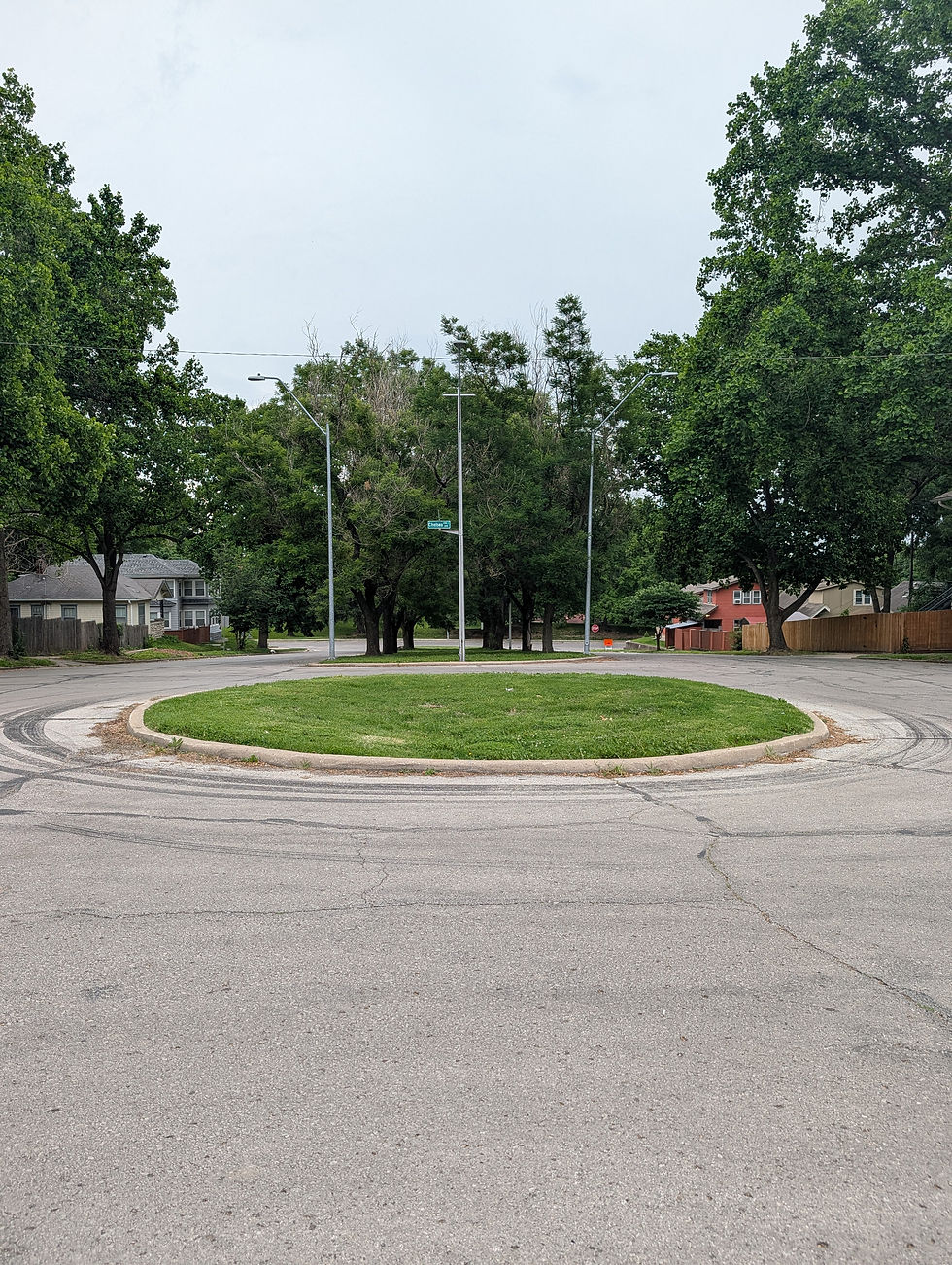
When I headed out for my morning walk yesterday, I turned right, instead of left to walk a few blocks to the Budd Park Esplanade. Kansas City Parks and Recreation has moved quickly on their commitments to the neighborhood to prepare spaces for native plantings, and I was interested to see what might have transpired since my trip to the site earlier in the week.
I drive this section of Van Brunt Boulevard daily, yet on foot it is a different world altogether. Behind the wheel, my eyes scan the horizon for a child, or wildlife, or a lost dog, lost in its own world, unaware of the potential danger of an inattentive driver steering 4,000 pounds of metal toward them. When I approach the stop sign, with drivers at each of the other three corners, I think "yield to the right" and wait to see if they are doing the same before going on my way.
Yet when I walk down the Boulevard, aside from watching out for uneven sidewalks, my mind is free to roam. Outside of the steel container I drive, I'm completely available to whatever I might encounter.
There's a circular island at the center of Budd Park Esplanade that will soon be densely landscaped with native plants, by an enthusiastic group of neighborhood gardeners, It's our inaugural project. The City offered to prepare this spot where weeds and grass have run amok for years. The first crew came with weedwhackers, cut it all down to the ground. The next crew came with heavy black tarps, and tacked them down over the freshly stripped ground. The last crew dumped five mounds of mulch about 8 feet in diameter and piled 3 feet high. Parks and Recreation had finished their part, and now it was our turn. Information gathered for the group, I looked forward to completing the daily ritual of my walk.
Backtracking my steps and heading north on the Boulevard, I switched to the west side of the road where my home is planted. Along the way are a few neglected trees. They're sad, I think. Since moving to the Historic Northeast a couple of years ago, my husband and I have bitched about how people tend to brutalize trees, or "prune" them by whacking off their tops. What's left is a trunk, amputated of its appendages. Missing them, I imagine.
But a friend of mine, involved with bird rescue and rehabilitation, and who keeps data on bird strikes at the college where she works, reminded me of something I knew and had selectively forgotten because of my aesthetic bias.
The practice of topping trees in the urban core is highly beneficial to our insect-eating bird populations. Many birds methodically search tree trunks for spiders, beetles, and little caterpillars tucked hidden into the crevices of the weather-worn, decaying wood. These foragers and bark gleaners are natural pest controllers. Most of us have seen some type of animated woodpecker climbing up and moving around on the hunt. Then there's the white-breasted nuthatch, who's a bit of an aerobic clown in that it walks upside-down searching for ants and spiders. Everywhere, including the urban core, there are birds who prefer a living menu in the summer over inanimate hard-shell seeds.
In the Hellstrip a few houses down from mine, there stands a tree that lives in hope of a better day. Whether it was topped off by a saw or a lightning strike is now inconsequential. Ivy spreads upwards along the trunk, and its branches are jagged spindles. I have stood on my front porch and glared at it, resentful of the image it projected on the rest of us.
But yesterday, I stopped at this gnarly mess for a closer look. Not expecting anything from this piece of botanical urban decay, I just stood there to look. Meditating upon it if you will.

A movement somewhere along the trunk heightened my senses. What's this? My eyes landed on a feathered body scrambling the trunk's diameter. It was a Northern Flicker, a bird I haven't seen since we lived in a gloriously wooded neighborhood in Asheville, North Carolina. A majestic bird, in my opinion.
I walk through nearby Kessler Park daily, and the woods are thick there, so I rarely see birds. There, I only hear birdsong, and sometimes record it with my Merlin app. But, along the Boulevard, this Northern Flicker found a tree that probably holds anywhere from 3,000 to 50,000 little carpenter ants.
In that instant, my concern about the impact of these trees on our property value dissolved.
Before moving back home, my husband and I lived near the old downtown area of Augusta, Georgia. In July of 2024, when we purchased on our house in the Historic Northeast, back in Augusta, they were cutting down 100 trees to make way for the Telfair Street improvements and streetscape makeovers. A sense of loss, anger, and helplessness swept through the community there, and still runs deep. Even when elected officials responsible have all been forced out and replaced, those old, old trees will not be forgotten. Nature needs our trees, whatever shape they're in, and we are all a part of nature.
Settled back in my hometown at long last, in a moment with this tree and its Northern Flicker – equilibrium and a special kind of peace, found me.
Comments